REVIEW · BUDAPEST
Budapest Art Nouveau Walking Tour
Book on GetYourGuide →Operated by insightcities.com · Bookable on GetYourGuide
Art Nouveau in Budapest hits fast.
If you like buildings with opinions, this tour is your kind of stroll through Ödön Lechner’s world and the Gresham Palace scene. I love how the guide turns facades into readable stories, and how you get inside key entrance halls so you can actually see the design details, not just guess at them from street level. One thing to plan around: some buildings have limited access on weekends, so the exact stops can shift depending on the day.
What makes it special is the mix of famous sights and the “look here” moments. You’ll learn the Hungarian take on Art Nouveau, often called Hungarian Secession, and how ceramic craft and Asian-inspired motifs show up across downtown architecture. The main consideration? The tour is 3 hours on foot, so you’ll want solid shoes and a pace that doesn’t mind frequent short stops.
In This Review
- Key Points Before You Go
- Hungarian Secession: Why This Art Nouveau Feels Like Budapest
- Meeting Up and How the Route Keeps Moving
- Bedő House and the “Read the Facade” Lesson
- The Hungarian State Treasury: Architecture as City Identity
- The Palace of the Royal Post: Lechner’s Postal Bank Energy
- Gresham Palace: Why Entrance Halls Matter
- Rózsavölgyi utca and Paris Passage: The In-Between Stops
- Zsolnay Porcelain in Action: Thonet House and the Ceramic Thread
- Flower Shop Interiors, Bank Offices, and the Art Nouveau Coffee House
- Asian Motifs Explained: Orientalism, Eastern Roots, and Design Logic
- Kazinczy Street Synagogue: The Art Nouveau Finale
- Price and Value: Why $123 Works If You Care About Details
- Who This Tour Is Perfect For
- Should You Book It?
- FAQ
- FAQ
- How long is the Budapest Art Nouveau Walking Tour?
- What’s included in the price?
- Are tram and metro tickets included?
- Is the tour guided in English?
- Can I enter the main buildings on the tour?
- What happens if I book for a weekend?
- Are there extra entry costs at certain stops?
Key Points Before You Go
- You see the style up close: entrance hall time at major stops helps you judge the architecture for real.
- Lechner and the Hungarian Secession angle: porcelain plus bold decoration, explained in plain terms.
- Zsolnay porcelain is a theme: you’ll connect ceramic production in Pécs to what you see on Budapest facades.
- Asian motifs have context: you learn why they appear and how Orientalism influenced the wider Art Nouveau wave.
- A thoughtful historian guide matters: strong praise is for guides like Anna, noted for being friendly and well versed in Budapest art and history.
- Weekend closures can change the route: the tour can adapt if the Hungarian National Bank or the synagogue isn’t accessible.
Hungarian Secession: Why This Art Nouveau Feels Like Budapest
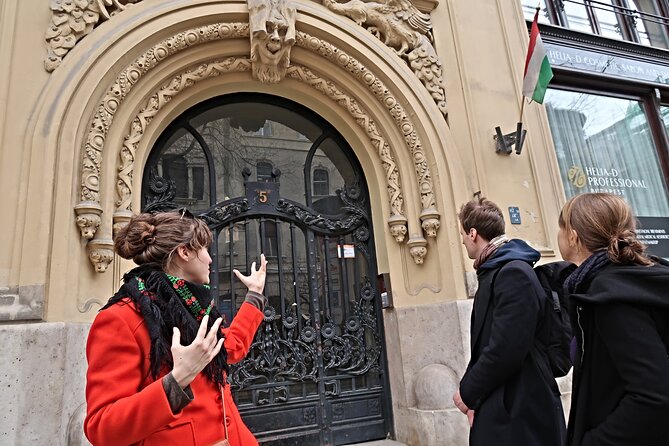
Budapest Art Nouveau isn’t just decoration for decoration’s sake. In the early 1900s, architects and designers were pushing back against what came before, using architecture, applied arts, and fine art as one big design statement. In Hungary, that shift took a distinctive direction, often tied to the Hungarian Secession movement.
That’s where Ödön Lechner comes in. The tour frames him as a kind of founding figure for this style, and once you understand his design logic, you start noticing patterns everywhere: the way ceramics get used like building language, and the way decorative motifs borrow from elsewhere while still feeling very local. The result is that the city stops looking like “pretty buildings” and starts looking like a design conversation.
What I like most is that you don’t need a design degree. The guide teaches you how to look—what to notice on the facade, and what those details are trying to communicate about Budapest’s early 20th-century self-image: confident, international, and full of energy.
You can also read our reviews of more walking tours in Budapest


Meeting Up and How the Route Keeps Moving
The walking portion runs about 3 hours, and it’s built as an efficient downtown circuit. You’ll be on streets where Art Nouveau lives in plain sight, but the tour still gives you time to stop, compare, and ask questions.
You may start from a central meeting point at Madal Café, Alkotmány u. 4, if you choose the option without hotel pickup. Since the tour depends partly on the day, you should also be ready for slight adjustments in what’s inside versus what’s viewable from the street.
Transport isn’t included. That matters because you’re likely covering multiple stops that are walkable, but not always comfortable in one go. If you’re pairing this with other sightseeing, plan your day so you don’t stack too many long walks back-to-back.
Bedő House and the “Read the Facade” Lesson
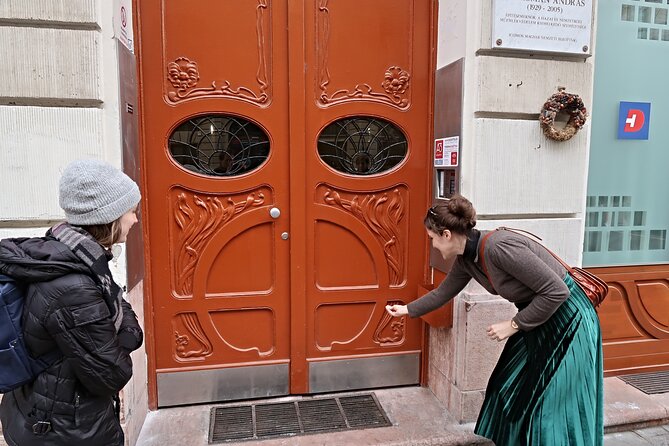
One of the tour’s strengths is that it doesn’t only hit the headline buildings. You also get stops like Bedő House, plus other Art Nouveau architecture along the route, which helps you see the bigger pattern. This is where the historian guide earns their keep.
You’ll learn the basic checklist the guide uses—how to interpret design choices without getting lost in jargon. Think of it as training your eyes. After a couple of these pauses, you stop seeing random ornament and start seeing a system: materials, color effects, layout choices, and motif placement all working together.
If you’re the type who usually walks past buildings without really “reading” them, this section is where the tour starts paying off.
The Hungarian State Treasury: Architecture as City Identity
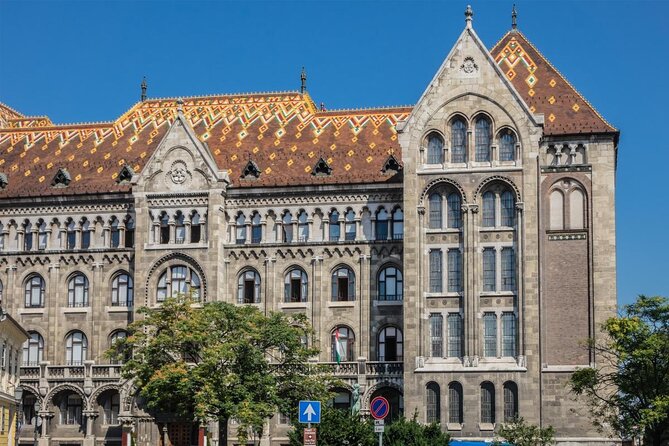
Next you’ll encounter the Hungarian State Treasury on the walk. Even if you mainly care about the flashy details, the value here is in the explanation—how official buildings in that era used style to signal power and modern taste.
Art Nouveau often gets described as playful, but in Budapest you’ll also see how it can be formal and authoritative. The guide’s context helps you understand why the design language could belong both to a café interior and to a serious civic facade.
The Palace of the Royal Post: Lechner’s Postal Bank Energy
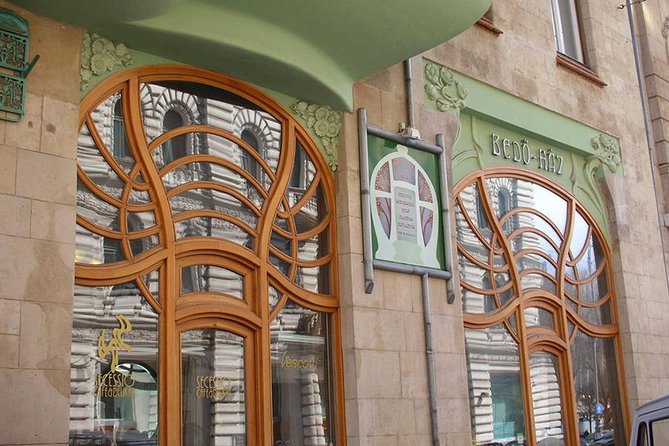
Then comes the star stop: the Palace of the Royal Post, connected to Lechner’s Postal Bank, often referred to as Hungary’s Gaudí. This is one of the moments where the tour earns the hype—because the building’s boldness isn’t subtle.
You get to take in the details outside, then you also get time at the entrance hall so you can see how the decoration behaves once you’re inside the building envelope. That entrance-hall access is a big deal. Street views can flatten architectural choices; inside, you can better understand scale and the rhythm of decorative elements.
Practical tip: slow down at this stop. Make yourself stand back first to read the facade as a whole, then move in for the smaller details. The guide will help you connect what you’re seeing to the Hungarian Secession approach.






Gresham Palace: Why Entrance Halls Matter
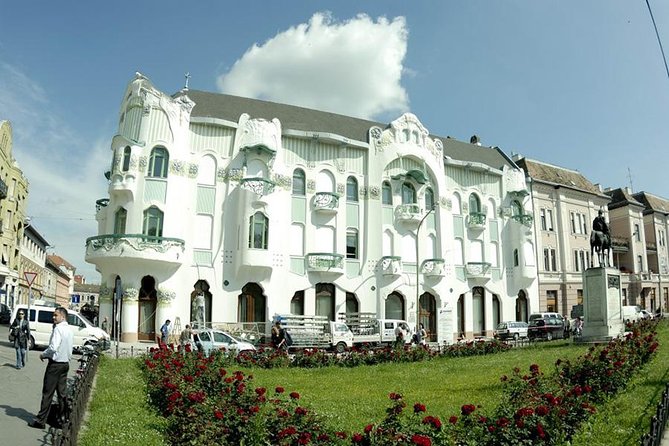
After the postal stop, you’ll visit Gresham Palace, another top highlight. The tour focuses on the palace’s facades and interior designs, and again, you’re given an important perk: you can access the entrance hall.
This is the difference between a photo tour and a real architecture tour. From the sidewalk, you can admire the look. In the entrance hall, you can feel the design intent. The guide points out the Art Nouveau design elements that might otherwise go unnoticed.
For me, this was the moment I stopped thinking of Art Nouveau as a style you either like or don’t. It’s more accurate to see it as a set of design tools—ways to manipulate light, proportion, and surface texture to make the building feel alive. Gresham Palace is a clear example.
Rózsavölgyi utca and Paris Passage: The In-Between Stops
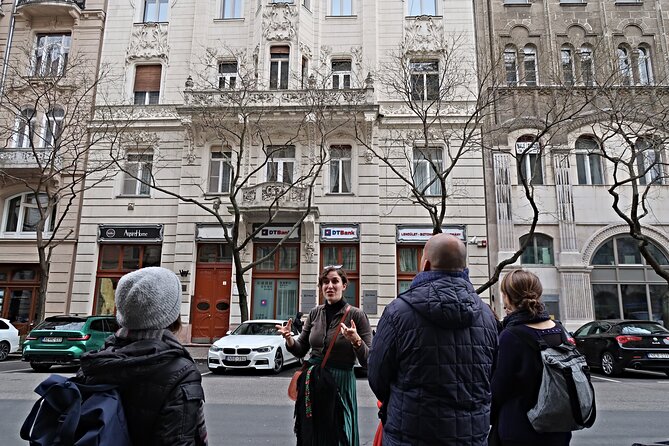
Not every Art Nouveau moment is a massive landmark. On this tour, you’ll also work through streets and spaces like Rózsavölgyi utca and Paris passage, where the atmosphere shifts. These are the stops that help you understand that Art Nouveau in Budapest wasn’t trapped in one neighborhood or only on official buildings.
Think of these as your palate cleansers. They keep the walking loop interesting while reinforcing the same lesson: the style shows up in everyday-facing architecture, not only in monuments.
If your favorite part of city walking tours is the “small pauses where the guide points at the detail you would never notice,” you’ll enjoy these segments.
Zsolnay Porcelain in Action: Thonet House and the Ceramic Thread
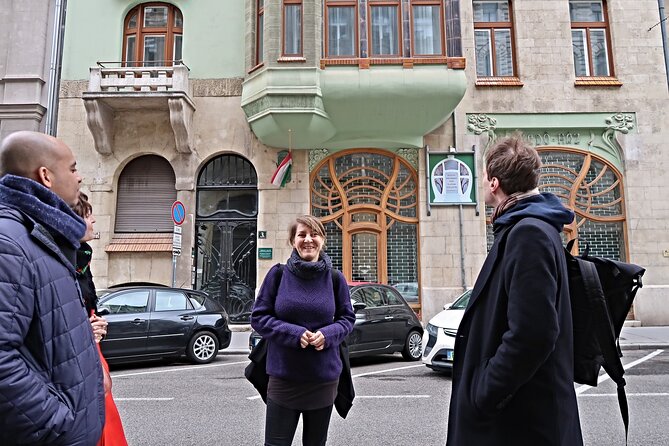
A major theme of the walk is ceramics, specifically Zsolnay porcelain. The tour doesn’t treat it like a trivia fact. It connects it to what you see on buildings and why the material mattered to the Hungarian Secession look.
You’ll examine ceramics tied to the Zsolnay factory in Pécs (in southern Hungary). Then you’ll connect that craft to architecture, including a stop focused on Thonet House, where the facades feature the kind of porcelain use that’s characteristic of Hungarian Art Nouveau.
If you’ve ever seen a building detail that looked like painted tile or glazed sculpture, you’ll appreciate what you learn here: Zsolnay tiles weren’t just decoration—they were part of the visual identity. They create a surface effect that reads as both ornamental and engineered.
Bonus value: once you understand this ceramic thread, you start spotting it elsewhere in Budapest on your own afterward. That’s the best kind of takeaway—knowledge that helps you keep exploring after the tour ends.
Flower Shop Interiors, Bank Offices, and the Art Nouveau Coffee House

The tour also includes smaller stops that make the style feel lived-in. You’ll see a flower shop with its original interior, plus other commercial and institutional spaces along the way, including department store details and bank offices.
This is where you get the “cosmopolitan” side of early 20th-century Budapest. Art Nouveau wasn’t only about official power—it was also the design language of customers, commerce, and public life.
You’ll even spend time at a small Art Nouveau museum and a coffee house. That combination works well because it gives you two angles at once: objects and design history on one side, and the social atmosphere that matched the era on the other. If you like tours where you can sit for a moment and reset, this stop rhythm is a smart choice.
Asian Motifs Explained: Orientalism, Eastern Roots, and Design Logic
One of the tour’s more fascinating sections deals with Asian motifs and elements in Hungarian Art Nouveau. The tour explains that these motifs connect to the supposed eastern origins of the Hungarian nation. You’ll also hear the broader European story: Orientalism influenced Art Nouveau across the continent.
Here’s the practical value for you. Once you know this is a shared design current—not random exotic decoration—you’ll be better at interpreting what you see. You won’t just spot patterns; you’ll understand the cultural framing and the design appeal.
This part is especially useful if you’re visiting Budapest for more than one day. It helps you connect dots between different buildings and see how the city participated in a wider design conversation.
Kazinczy Street Synagogue: The Art Nouveau Finale
The tour ends at Kazinczy Street Synagogue, specifically the orthodox synagogue with an Art Nouveau interior. This stop is the kind of finale that sticks, because it shifts the style from civic and commercial to sacred space.
If you’re interested in how design changes when it serves a different purpose—worship rather than street life—you’ll appreciate the contrast. The tour gives you time to take in the interior approach, guided by the historian.
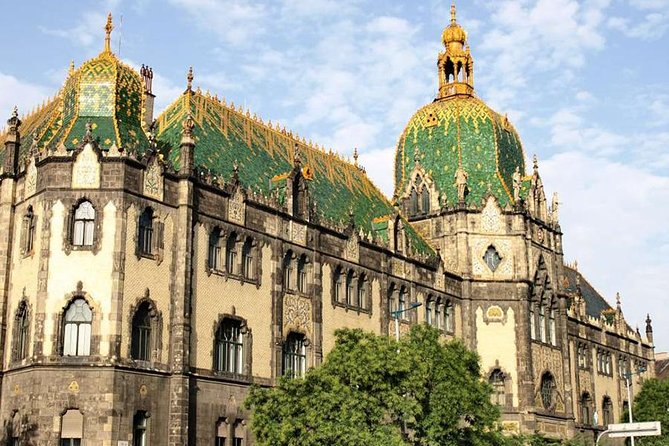
Important planning note: the synagogue is closed on Saturdays. If you’re booking for a Saturday, the tour can be adapted, or it can be extended to include other Art Nouveau sites such as the Gellért Bath Hotel, the Museum of Applied Arts, and the Geology Museum.
There may also be a small extra charge to enter the synagogue (listed as 2000 HUF, about $7.00). The tour data also notes additional costs may apply if other sites are open, including House of Hungarian Art Nouveau at 1000 HUF, about $3.50.
Price and Value: Why $123 Works If You Care About Details
At $123 per person for a 3-hour guided walk, this is not the cheapest thing you can do in Budapest. The reason it can still feel like good value is the focus: an expert art/architecture historian guide, plus entrance access at major buildings, plus a theme-based route that ties together architecture, ceramics, and motifs.
If you’re the type of visitor who likes taking a few great photos, you might find this price steep compared with a self-guided walk. If you want your time to convert into real understanding—how to read Hungarian Secession design, why Zsolnay porcelain matters, and what Asian-inspired motifs mean in this style—then the price becomes easier to justify.
Also, the tour is offered in private or small groups. That matters because shorter tours work best when you can ask questions and not feel rushed.
You’ll want to budget time and energy, too. Since tram/metro tickets aren’t included, it’s smart to plan your day so you’re not scrambling at the end.
Who This Tour Is Perfect For
This experience is a great fit if you:
- Like architecture that uses material (especially ceramics) as a design tool.
- Want a guide who connects the look to the bigger story of Budapest’s early 1900s confidence.
- Enjoy interior moments, not just exterior facades.
- Plan to keep exploring after the tour with a trained eye.
It’s also a good option if you’re visiting for a limited number of days. In three hours, you’re covering a concentrated slice of the Art Nouveau conversation in Budapest, with a strong emphasis on Hungarian Secession specifics.
Should You Book It?
If you’re even mildly interested in Art Nouveau, I think you should book this tour—especially if you care about understanding what you’re looking at. The combination of entrance hall access at key buildings, the Zsolnay porcelain thread, and the explanation of Asian motifs gives you more than a basic sightseeing loop.
I’d think twice only if you plan to visit on a Saturday and you strongly want the synagogue interior, since it’s closed that day. Still, the tour can adapt with other Art Nouveau stops, so the style focus stays intact.
If your goal is to leave Budapest with a sharper eye for Belle Époque design and a better sense of how Lechner’s ideas shaped the city, this walking tour is a solid use of your time.
FAQ
FAQ
How long is the Budapest Art Nouveau Walking Tour?
It lasts 3 hours.
What’s included in the price?
The tour includes a 3-hour walking tour with a historian guide.
Are tram and metro tickets included?
No. Tram and metro tickets aren’t included.
Is the tour guided in English?
Yes, the live guide is English.
Can I enter the main buildings on the tour?
You can enter the entrance halls of the Royal Post (Postal Bank) and Gresham Palace to see details both outside and with a peek inside.
What happens if I book for a weekend?
On weekends, you may not enter the Hungarian National Bank, and the Orthodox Synagogue is closed on Saturdays. The tour can be adapted to your interests or extended to include other Art Nouveau sites.
Are there extra entry costs at certain stops?
There may be additional costs if certain sites are open, including House of Hungarian Art Nouveau (1000 HUF) and the Orthodox Synagogue on Kazinczy Street (2000 HUF).