REVIEW · BUDAPEST
Budapest Private Tuk Tuk Half-Day Tour
Book on Viator →Operated by Budapest TukTuk · Bookable on Viator
Four hours on a tuk-tuk changes your Budapest game. This private ride strings together big landmarks across Buda and Pest with an English-speaking guide, and it’s built for fast orientation. I especially like how the route mixes iconic stops with photo-friendly viewpoints, and how guides such as Zoltán tend to turn each pass-by into an easy story you can actually remember.
I also like the convenience: pickup and drop-off in the wider downtown area means you spend less time wrestling with transit and more time seeing the city. One consideration: it’s a half-day format with limited time at each spot, and the tuk-tuk ride can feel a bit jostly, so if you have a sensitive back you’ll want to plan accordingly.
In This Review
- Key Takeaways Before You Ride
- A Tuk-Tuk Shortcut Between Buda and Pest
- Price and What You Really Get for $178.98
- Before You Go: Pickup, Timing, and Weather Reality
- Pest Highlights: St. Stephen’s, Andrássy Avenue, Opera, and Heroes’ Square
- Széchenyi Baths and the Party-Quarter Edge
- Jewish Quarter Landmarks: Dohány Street Synagogue and Károlyi Garden
- University Church, Kálvin tér, and the Great Market Hall
- Crossing to Buda: Liberty Bridge and Gellért Bath Area
- Gellért Hill View Stops: Citadella, Freedom Statue, and Garden of Philosophy
- Castle District Classics: Castle Hill, Fisherman’s Bastion, Matthias Church
- Danube Memorials and Parliament: Shoes, Bridges, and Országház Views
- Tuk-Tuk Comfort: Photos, Jostling, and How to Make the Most of It
- Who This Tour Suits Best (and Who Should Skip It)
- Should You Book This Budapest Private Tuk Tuk Half-Day Tour?
- FAQ
- How long is the Budapest private tuk-tuk half-day tour?
- What language is the guide?
- Is hotel or downtown pickup included?
- Does the tour include drop-off as well?
- Are admission tickets included for attractions like Parliament or Matthias Church?
- Is a Danube cruise included?
- Can I choose my departure time?
- How much can the schedule change?
- What if the weather is bad?
- How big is a tuk-tuk group, and what if my party size is odd?
Key Takeaways Before You Ride
- Private tuk-tuk, just your group: no waiting for strangers, and the guide can shape the pacing.
- Pickup and drop-off in wider downtown: fewer logistics headaches right at the start.
- Buda + Pest in one outing: you’ll see the “greatest hits” quickly, without booking separate tours.
- Guides who help with photos and storytelling: people highlight guides like Norbert, Greg, and Martin for photos and context.
- Half-day means quick looks: expect exterior views and short stops, since entry tickets aren’t included.
A Tuk-Tuk Shortcut Between Buda and Pest
Budapest can feel like two different cities wearing the same name tag. The Danube cuts the city into Buda on the hills and Pest on flatter streets, and the quickest way to get your bearings is to see both in one day.
That’s where a private tuk-tuk half-day tour shines. You get a small, motorized ride that can reach places that are harder to access by foot or large bus. More importantly, it’s built for the reality of travel: you’re tired, you have only a few hours, and you want your first day to reduce uncertainty fast.
On this tour you’ll jump between famous areas and viewpoints—basilicas, bridges, bath landmarks, synagogues, parliament views—without turning the outing into a marathon. It’s not about “deep” exploration of every building. It’s about building a mental map you can use for the rest of your trip.
You can also read our reviews of more private tours in Budapest



Price and What You Really Get for $178.98
At about $178.98 per person for roughly four hours, this isn’t a budget city bus deal. But it’s priced like what it is: a private experience with an English-speaking guide and logistics handled for you.
Here’s how the value math usually works in Budapest:
- If you’re doing major sights in a short window, paying for a guide often beats spending half your time figuring out routes and where to park.
- Pickup and drop-off in the wider downtown area can save real time—time you’d otherwise spend traveling between different districts.
- You’re not just buying transportation. You’re buying someone who can point out what you’re looking at—St. Stephen’s Basilica, Andrássy Avenue, the Opera House, the Castle District—and explain how the city pieces connect.
The only catch is that you’re paying for a “see it and orient yourself” tour, not for admission to interiors. Entry tickets aren’t included, so if you want to go inside big-ticket sites, budget separately.
Before You Go: Pickup, Timing, and Weather Reality
This tour offers free pick-up in the wider downtown area and ends back at the meeting point. You choose your preferred departure timing, and you’ll receive confirmation at booking.
Two practical notes matter:
- The advertised time may shift, with a maximum change of 1.5 hours.
- It runs best in favorable weather. If it’s canceled due to poor weather, you’ll be offered an alternative date or a full refund.
Also plan for comfort in motion. A few reviews mention the ride can be jostly, and another notes blankets helped in winter. So dress for the actual conditions—cool wind on the hills is no joke—and consider layers even if the morning starts mild.
Pest Highlights: St. Stephen’s, Andrássy Avenue, Opera, and Heroes’ Square
Your half-day often starts in central Pest, then stretches toward the city’s grand boulevards and monuments.
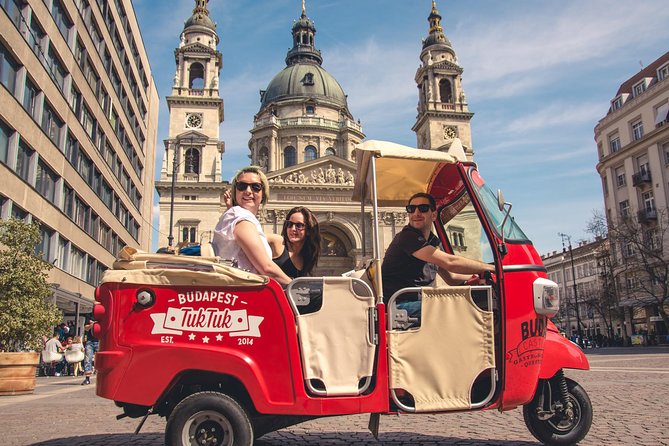
St. Stephen’s Basilica is the first landmark style hit. Named for Stephen, the first king of Hungary, it’s famous for the tradition around his right hand housed in a reliquary. Even if you don’t go inside, the scale tells you why this is one of the city’s anchors.
Then you’ll roll along Andrássy Avenue, a boulevard dating back to 1872 and recognized as a World Heritage Site. Expect that long, elegant “look up” moment: Neo-Renaissance mansions and townhouses line the street like a timeline. This stretch also leads you toward the grand civic identity of Budapest.
You’ll pass the Hungarian State Opera House, a neo-Renaissance building designed by Miklós Ybl. It’s the kind of stop that works well from a moving vehicle because the façade is meant to be seen at an angle, not just from one side of a street.
From there, the tour heads toward Heroes’ Square. This is where Budapest goes theatrical: the statue complex includes the Seven chieftains of the Magyars plus other national figures, and there’s a Memorial Stone of Heroes—often mistakenly called the Tomb of the Unknown Soldier. It’s free to spend time there, and the 15-minute stop is usually enough to take photos without feeling rushed.
Széchenyi Baths and the Party-Quarter Edge
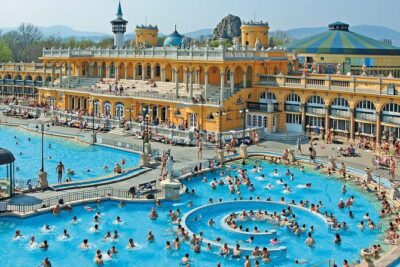
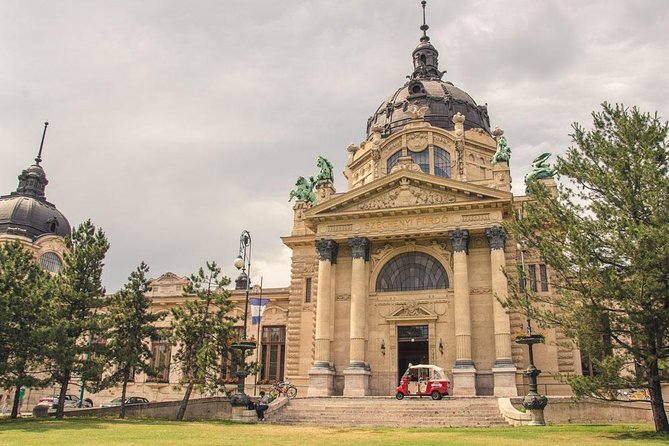
Next, you’ll reach the area around Széchenyi Medicinal Bath, described as the largest medicinal bath in Europe. One neat detail: the water comes from two thermal springs at about 74°C and 77°C. Even if you don’t go in, it’s worth seeing because the complex looks like a whole resort from the outside.
From there the route typically brushes the northwestern boundary of the historic Jewish Quarter and the “party quarter” area. You’ll notice the change in street texture: more nightlife energy, more pedestrians, and a different kind of city rhythm than around the basilica or grand boulevards.
You can also read our reviews of more tours and experiences in Budapest



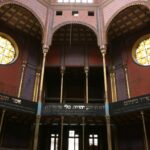

Jewish Quarter Landmarks: Dohány Street Synagogue and Károlyi Garden
If you like Budapest when it shows multiple layers—religion, culture, and survival—this part of the route matters.
You’ll stop near Dohány Street Synagogue, also known as the Great Synagogue. It’s the largest synagogue in Europe, seating around 3,000. Even without going inside, the building’s size and presence make it clear this is more than an old landmark; it’s still a community focal point.
You’ll also pass Károlyi Garden, a public park in District V. It’s noted as the oldest garden remaining in its function in downtown and among the best documented palace gardens in Hungary. It’s a nice reset—green space that breaks up the “look at buildings all day” feeling.
University Church, Kálvin tér, and the Great Market Hall
Budapest has a strong street-life vibe, and these stops are good for catching it.
You’ll see the University Church at Egyetem tér, surrounded by restaurants and cafés. It’s near the Small Boulevard, and the area feels like a student zone during the day—then shifts gears at night.
At Kálvin tér, you’ll get another key square moment. The square is named after John Calvin, and it’s tied to the large Reformed Church there.
Finally, the tour heads to Central Market Hall (Great Market Hall), the largest and oldest indoor market in Budapest. This is one of the best places to understand what locals shop for and how markets shape daily life. The tour stop is time-limited, so it’s best for scanning stalls and grabbing quick food ideas rather than turning it into a full shopping spree.
Crossing to Buda: Liberty Bridge and Gellért Bath Area
To get from Pest toward the hill districts, you’ll cross using bridges designed for “transition moments.”
Liberty Bridge connects Buda and Pest across the Danube and is the third southernmost public road bridge in Budapest. It was originally named the Franz Joseph Bridge—a small reminder that Budapest’s names and identities have shifted over time.
On the Buda side, you’ll reach the Gellért Thermal Baths and Swimming Pool, part of the Hotel Gellért complex. Even if you don’t enter, this is a memorable landmark: the baths are a huge part of Budapest’s reputation, and the building presence gives you that sense of “this city runs on thermal water.”
Gellért Hill View Stops: Citadella, Freedom Statue, and Garden of Philosophy
Now comes the “look over everything” segment.
Citadella (Citadella) sits atop Gellért Hill. It’s a citadel-style fortification with strategic military importance in Budapest’s history, and it’s a quick stop with time set aside to take in the view.
Nearby, you’ll see the Freedom Statue (Szabadság-szobor) on Gellért Hill. It commemorates those who sacrificed their lives for independence, freedom, and prosperity of Hungary. This stop often lands well because it’s outdoors and visual—perfect for a short photo break.
Another fun-to-walk-around moment is the Garden of Philosophy, above the reservoir below Gellért Hill. There are fewer tourists here and the view can be excellent. There’s also a notable concept sculpture idea—figures like Jesus Christ and Buddha shown together—meant to spark reflection, not debate.
Castle District Classics: Castle Hill, Fisherman’s Bastion, Matthias Church
Once you climb into the Castle District area, Budapest feels like it’s holding court.
Castle Hill is a limestone plateau about 170 meters above the Danube and recognized as a UNESCO World Heritage Site. Below it is a network of caves formed by thermal springs, described as 28 km long. Even if you don’t tour underground, knowing the ground is shaped by springs adds an interesting layer to why this area is so important.
You’ll also spend time around the Castle Garden, described as an art-and-nature “jewelry box” where history, culture, and nature meet. It’s the kind of place you can glance through in minutes and still feel the vibe shift.
Then you reach Fisherman’s Bastion. It’s a terrace-style viewpoint in neo-Gothic and neo-Romanesque style, designed and built between 1895 and 1902 from plans by Frigyes Schulek. The design is theatrical but in a good way: you’re there for the angles and the panorama.
Just nearby is Matthias Church, located in the heart of Buda’s Castle District. Tradition traces its origins to 1015 in Romanesque style, even though no archaeological remains exist. Important practical detail: admission isn’t included here, so treat this as an exterior/short-stop moment unless you’ve planned separate tickets.
Danube Memorials and Parliament: Shoes, Bridges, and Országház Views
The final stretch often connects the emotional side of Budapest with the grand political side.
You’ll pass the Shoes on the Danube Bank memorial. It’s a tribute to Jews killed by Arrow Cross militiamen during World War II. The memorial was conceived by film director Can Togay and created with sculptor Gyula Pauer. This is one of those stops that’s brief by schedule but heavy in meaning. If you want to linger, you’ll need a bit of extra time, because the half-day format doesn’t allow deep emotional processing.
Then you’ll see another bridge connection—often Margaret Bridge (Margit híd)—which links Buda and Pest and connects Margaret Island too. It’s described as the second-northernmost and second-oldest public bridge in Budapest.
Finally, you’ll arrive near Hungarian Parliament Building (Országház). It’s the seat of Hungary’s National Assembly and a landmark tourist destination. The tour focuses on viewing time only; internal visits aren’t included, so if you want to go inside, plan that as a separate booking.
Tuk-Tuk Comfort: Photos, Jostling, and How to Make the Most of It
A tuk-tuk can be a fun way to see the city, but you need the right expectations.
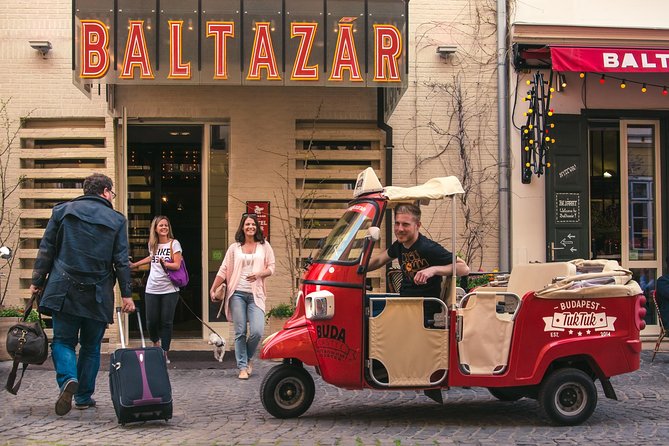
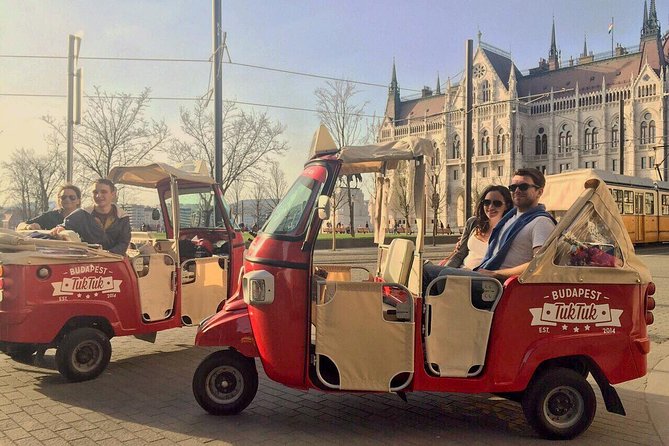
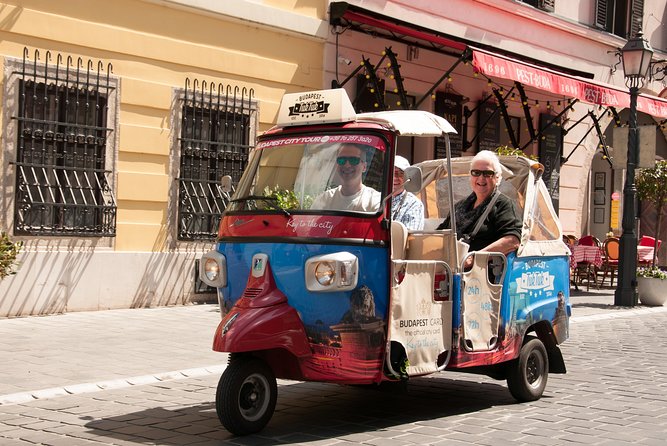
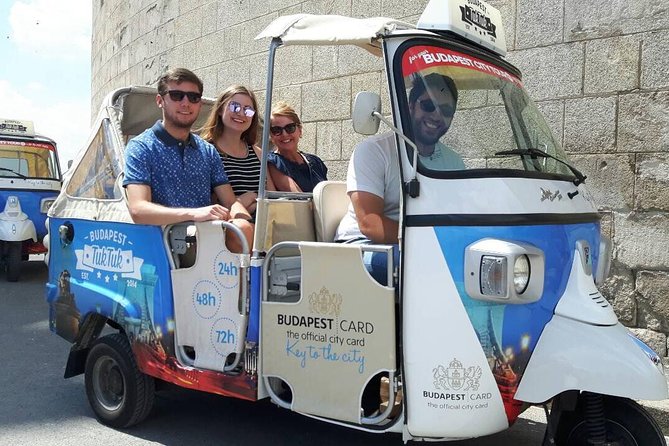
First, seating. A tuk-tuk is comfortable for 2–3 people. If your group has an odd number, you’ll want to specify whether you want someone seated in another tuk-tuk. That matters because small group sizing affects how cozy things feel.
Second, motion. The ride is part of the charm, but one comment notes it can jar if you have a bad back. If that’s you, don’t assume it’ll feel like a smooth city car. Consider wearing supportive shoes and dressing in a way that lets you sit comfortably without fidgeting.
Third, photos. Many people highlight guides taking great shots. So don’t be shy: tell your guide what you want—Castle views at golden hour, Parliament angles, or quick portraits with the Chain Bridge-area vibe.
Finally, blankets. In cooler weather, the tour may include blankets to help. At minimum, bring layers and a windproof top. Budapest gets breezy, especially on hill viewpoints.
Who This Tour Suits Best (and Who Should Skip It)
This is a strong match if:
- You’re first-time in Budapest and want an orientation tour that connects the dots.
- You’re short on time but still want a wide sweep across key districts.
- You prefer a private guide over a crowded bus.
- You want a guide to tailor pace and make quick adjustments if you’re moving slowly.
It may not be your best choice if:
- You’re aiming to do lots of interior ticketed attractions during the half-day.
- You dislike a slightly bumpy ride or you have a sensitive back.
- You want long stays at fewer places. This tour trades time for coverage.
One tip: if you can, book this early in your trip. A first-day overview helps you plan the rest—where to return for longer photo time or where to schedule tickets you care about.
Should You Book This Budapest Private Tuk Tuk Half-Day Tour?
I’d book it if you want a smart, private hit of Budapest’s top sights with minimal hassle. The best value is for orientation: Buda hills, Pest centers, major squares, bridges, and the Danube’s most unforgettable memorial moments—done in a way that usually feels fun, not exhausting.
Skip or rethink it if your priority is interior admissions and long museum-style visits, because entry tickets aren’t included. And if comfort is a big concern, don’t ignore the jostling note—plan for it with layers and a bit of practical realism.
If you want a half-day that gives you a workable map and memorable snapshots, this tour is a very reasonable way to start.
FAQ
How long is the Budapest private tuk-tuk half-day tour?
It runs for about 4 hours.
What language is the guide?
The guide speaks English.
Is hotel or downtown pickup included?
Yes. Free pick-up is offered in the wider downtown area.
Does the tour include drop-off as well?
Yes. Free drop-off is included in the wider downtown area, and the tour ends back at the meeting point.
Are admission tickets included for attractions like Parliament or Matthias Church?
No. Entry tickets are not included.
Is a Danube cruise included?
A Danube sightseeing cruise is included only if you select that option.
Can I choose my departure time?
Yes. The tour offers choice of departure times, and you can indicate your preferred pick-up time and location.
How much can the schedule change?
The advertised time may change, with a maximum change of 1.5 hours.
What if the weather is bad?
The tour requires favorable weather. If it’s canceled due to poor weather, you’ll be offered an alternative date or a full refund.
How big is a tuk-tuk group, and what if my party size is odd?
A tuk-tuk is comfortable for 2–3 people. If you have an odd number, specify if you want one traveler seated in another tuk-tuk.