REVIEW · BUDAPEST
Pest side stories with a Historian
Book on Viator →Operated by Budapest Explorers · Bookable on Viator
Street history moves at walking pace. This Pest tour uses a historian to turn major landmarks and everyday squares into a clear, human story of Budapest across centuries. You’re not just looking at buildings—you’re learning how the city got the way it is.
I like two things a lot. First, it stays small, capped at 10 guests, so questions feel normal instead of rushed. Second, the tour includes real add-ons: your guide, refreshments, and metro tickets, so you can spend your time on the walk, not on figuring out transit.
One possible drawback: this is a 3-hour walking route, so it’s not a sit-down sightseeing program. Also, entry into St. Stephen’s Basilica is optional and depends on the group’s interest, so plan to see the church from the outside either way.
In This Review
- Key Highlights Worth Marking on Your Map
- Why This Pest Walk Beats the Big-Bus Shuffle
- Starting at Kempinski: A 2:00 pm Plan That Sets You Up
- Elizabeth Square: From Market to Stalin Square to a Night-Out Hub
- St. Stephen’s Basilica: Huge Outside Views, Possible Inside If the Group Wants
- Heroes’ Square: Your 1,100-Year Hungarian Timeline in 30 Minutes
- Vajdahunyad Castle: Why a Medieval-Looking Castle Was Built in 1896
- Andrassy Avenue: UNESCO Since 2002, With a Local’s Pride Feel
- Vorosmarty Square: Commerce, High-End Goods, and Central Pest Energy
- Millennium Underground: The Oldest Underground on the European Continent
- Price and Value: What $58.94 Buys You in Real Budapest Time
- Timing, Walking, and How to Make It Comfortable
- Where This Tour Fits Best (and When to Skip)
- Should You Book Pest Side Stories With a Historian?
- FAQ
- How long is the tour?
- How many people are in the group?
- Is the tour offered in English?
- Are there admission fees for the stops?
- Where does the tour start and end?
- Can I cancel for a full refund?
Key Highlights Worth Marking on Your Map
- Elizabeth Square’s quick transformation from market square to Stalin-era square and bus station, now a youth party area
- Heroes’ Square as a history starter kit focused on more than 1,100 years of Hungarian history
- Vajdahunyad Castle’s 1896 medieval-style question that a guide explains with stories you can actually remember
- Andrassy Avenue UNESCO street time with a “this is why it matters” perspective on a major Budapest boulevard
- Millennium Underground’s claim to age as the oldest underground on the European continent
- Max 10 people plus refreshments and transit help so you’re not doing logistics math while you sightsee
Why This Pest Walk Beats the Big-Bus Shuffle
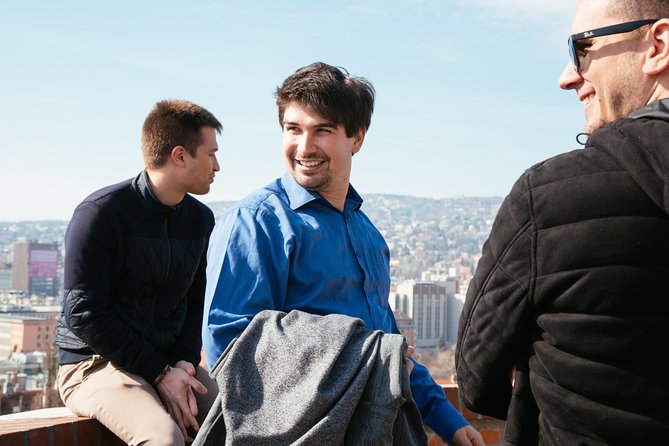
Budapest is easy to overwhelm. You’ll see great stuff from the outside, but it takes context to understand what you’re looking at. This tour solves that with a historian guide and a route that sticks to central Pest landmarks you can connect quickly.
The small group size is a real quality-of-life upgrade. With a cap of 10, you get more back-and-forth, and you’re less likely to feel like a number in a long line. And when you’re walking in the heat or rain, a smaller group keeps the pace more forgiving.
If you’re comparing this to cruise-bus style sightseeing, the difference is how the story gets told. Some guides (like Steven “the Tall,” Greg, and Andrew/András, based on past group experiences) are especially good at linking what you see—statues, facades, major squares—to conflict, belief, and everyday life. That makes the whole route feel less like a checklist.
You can also read our reviews of more tours and experiences in Budapest.



Starting at Kempinski: A 2:00 pm Plan That Sets You Up
The tour starts at Kempinski Hotel Corvinus Budapest, address Erzsébet tér 7–8, 1051. It kicks off at 2:00 pm, and your walk is designed as a compact arc through central Pest.
Ending is at St. Stephen’s Basilica (Szent István tér 1, 1051). The operator notes it might end at another central point of Pest close to where you began, depending on how things flow that day. Either way, you finish in a spot that’s easy to continue exploring on foot or by transit.
A mobile ticket makes check-in simpler, and the tour is offered in English. Service animals are allowed, and it’s described as suitable for most travelers, with the route close to public transportation along the way. That matters because “walking tour” still has to fit real legs and real weather.
Elizabeth Square: From Market to Stalin Square to a Night-Out Hub
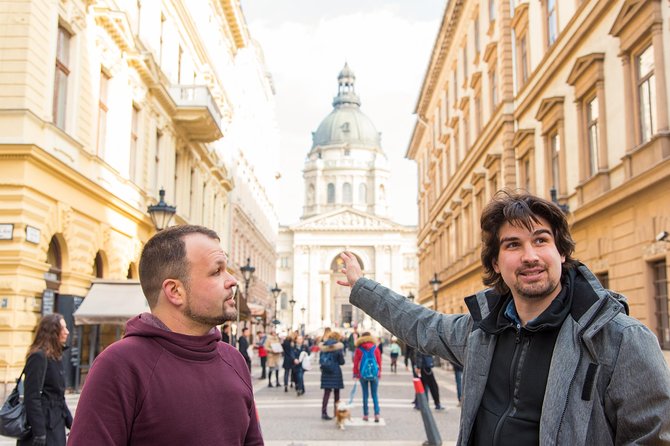
Elizabeth Square is the first stop, and it’s a smart one for getting oriented fast. You’ll hear how this place changed names and functions over time—from a market square to a Stalin-era square and even a bus station—before it became the young, party area it’s known for today.
In about 20 minutes, the historian approach helps you notice details that most people miss. You’re not just passing by statues; you’re learning what they represent and why they appeared in this exact spot. It’s a great example of how central Pest can feel “modern” while still carrying heavy history.
Practical note: if you’re a photo person, this is one of your better stops early. You’ll have just enough time to photograph without feeling like you’re sprinting to keep up.
St. Stephen’s Basilica: Huge Outside Views, Possible Inside If the Group Wants
Next comes St. Stephen’s Basilica (Szent István Bazilika), and the tour gives you a choice point. The basilica is described as the largest church in Budapest, and the group may go inside if there’s interest.
Expect about 20 minutes here. Even if you don’t enter, it’s still a strong moment for learning. Big churches tend to attract symbolism—where people point, what they build, what they preserve—and a historian guide can help you read the building like a message, not just a pretty facade.
If you want to go in, keep in mind that your exact experience depends on the group decision. Plan your expectations with that in mind, so you’re not disappointed if you stay outside.
Heroes’ Square: Your 1,100-Year Hungarian Timeline in 30 Minutes
Then you’re at Heroes’ Square, one of Pest’s most important introductions into Hungarian history. The tour frames it as a place that covers more than 1,100 years, which is a lot of time to fit into a city walk.
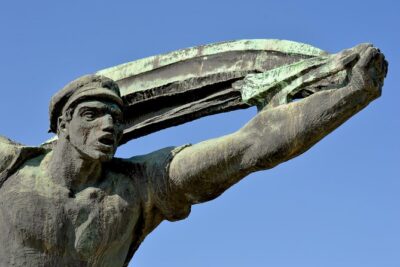
You’ll spend around 30 minutes here, which is exactly long enough to understand the big idea and still move on. This stop works especially well because Heroes’ Square is visual. Statues and monuments do the heavy lifting, and the historian helps connect those visuals to the story.
A helpful tip for you: let your guide set the order of ideas. If you jump straight into taking photos, you might miss the main thread. Give yourself a minute to listen first, then the square becomes much easier to “read.”



Vajdahunyad Castle: Why a Medieval-Looking Castle Was Built in 1896
If you like your history a little odd, this stop is for you. Vajdahunyad Castle looks medieval, but it was built in 1896, and the tour focuses on why and how that look came to be.
You get about 30 minutes, and the time is used for explanation, not just sightseeing. This is one of those places where a guide turns confusing facts into a story you can picture. You’re learning how an idea of the past can be built in the present—literally in stone and structure.
This is also one of the stops that tends to feel less crowded than the headline landmarks. If you want a break from the “everyone is here” feeling, this castle stop is a strong option during the afternoon walk.
Andrassy Avenue: UNESCO Since 2002, With a Local’s Pride Feel
Andrassy Avenue is next, and it’s presented as a pride point of Budapest. It’s a UNESCO World Heritage site since 2002, and the tour uses that to shift your thinking from street-level to city-scale.
You’ll spend about 30 minutes, long enough to walk key segments and still absorb the story. The historian angle here is important: it’s easy to see a boulevard and miss the planning behind it—how a major city street signals power, culture, and identity.
Expect this stop to feel a bit more “city” than “monument.” You’ll notice architecture and scale more than you’ll chase individual facts. That’s good. You need variety in a 3-hour walk, and this is where you reset your eyes.
Vorosmarty Square: Commerce, High-End Goods, and Central Pest Energy
Then comes Vörösmarty Square (Vorosmarty ter), focused on the commercial side of central Pest. The tour describes it as being in the heart of historical Pest, with attention on commerce and high-end products.
This stop is shorter—around 15 minutes—which makes it perfect as a connector between larger sights. Use it to scan the scene: where people walk, how streets funnel, and how “money and culture” coexist in a central square.
Even if shopping isn’t your goal, this stop helps you understand the city’s everyday rhythm. History isn’t only palaces and heroes. It’s also markets, stores, and where people gather to spend an afternoon.
Millennium Underground: The Oldest Underground on the European Continent
Finally, you’ll reach Millennium Underground—described as the oldest underground on the European continent. You’ll spend about 30 minutes, and this stop adds a practical wow-factor.
What makes it work on a walking tour is the mix of modern-day use and deep-time significance. You’re looking at transit history in a city that still relies on the same idea: moving people efficiently, quickly, and safely.
A good move for you: slow down here and look at details your eyes usually ignore in transit settings. When your guide frames the place historically, you’ll start noticing design choices and what the city likely wanted to communicate when it built underground.
Price and Value: What $58.94 Buys You in Real Budapest Time
At $58.94 per person for roughly 3 hours, the real value isn’t just the guide—it’s how the inclusions reduce your in-the-moment costs and friction.
You get:
- A historian guide
- Refreshments
- Metro tickets
- Mobile ticket access
- Free admission noted for the stops on the schedule
When you add metro help to a walking route in central areas, it often means less time solving logistics. And refreshments are not a small detail in Budapest, where afternoons can get hot or just feel long when you’re moving.
Also, this tour is frequently planned ahead. The average booking window is about 32 days in advance, which tells me it’s popular enough to sell out on good-weather days and for limited English slots. If your Budapest dates are fixed, don’t procrastinate.
Timing, Walking, and How to Make It Comfortable
This tour is built around short stops—usually 15 to 30 minutes each—with plenty of movement in between. That’s a great format because it keeps the story from dragging. But it also means you should come prepared for constant walking.
Bring:
- Comfortable shoes you trust for uneven sidewalks
- A water bottle (and use the refreshments when offered)
- Sun or rain protection, especially on a 2:00 pm start
Pace matters, and the operator notes that most travelers can join. In past experiences with guides like Andrew/András, the pacing is often described as manageable even when the route covers a lot of ground. Still, if you know your limits, you’ll enjoy it more if you manage your energy early.
Where This Tour Fits Best (and When to Skip)
This is best for you if:
- You want a guided historical story instead of “photo-stop tourism”
- You like small groups capped at 10
- You want central Pest landmarks connected into a bigger timeline
- You prefer walking tours with practical inclusions like transit help and refreshments
It might not be the best match if:
- You want mostly inside-the-building time. St. Stephen’s Basilica entry is conditional, not guaranteed.
- You dislike walking for 3 hours straight, even at a reasonable pace.
If you’re already strong on Hungarian history and want purely deep specialist content, you might find the stops feel broad. But the tour’s strength is that it gives you bearings fast and makes the city readable.
Should You Book Pest Side Stories With a Historian?
I think you should book this tour if you want Pest to make sense. The route hits major anchors—Elizabeth Square, Heroes’ Square, Vajdahunyad Castle, Andrassy Avenue, Vörösmarty Square, and Millennium Underground—and the historian approach links them into a story you can carry beyond the tour.
If small-group attention matters to you, this is a strong choice with a cap of 10 and frequent chances to ask questions. And the inclusions—metro tickets plus refreshments—make it feel like you’re paying for time saved as well as information gained.
One final check: decide if you’re okay with a walk-heavy afternoon where one major indoor stop (the basilica) depends on the group’s interest. If that works for you, this is a smart, cost-effective way to get real context in central Budapest Pest.
FAQ
How long is the tour?
The tour runs for approximately 3 hours.
How many people are in the group?
The experience has a maximum of 10 travelers.
Is the tour offered in English?
Yes, it’s offered in English.
Are there admission fees for the stops?
The tour information lists admission tickets as free for the scheduled stops. St. Stephen’s Basilica entry is noted as optional if the group is interested.
Where does the tour start and end?
It starts at Kempinski Hotel Corvinus Budapest at Erzsébet tér 7–8, 1051, and it ends at St. Stephen’s Basilica at Szent István tér 1, 1051. It may end at another central point of Pest close to the starting area.
Can I cancel for a full refund?
Yes. You can cancel up to 24 hours in advance for a full refund. If you cancel less than 24 hours before the start time, the amount paid is not refunded.