REVIEW · BUDAPEST
Sightseeing Cruise on the Danube with Audio Guide in Budapest
Book on Viator →Operated by Silverline Cruises Kft. · Bookable on Viator
One hour can feel like a whole evening. This Danube sightseeing cruise puts Budapest’s best-lit landmarks on your camera roll, with an open terrace when you want fresh air and a phone audio guide when you want context.
I like that you get a front-row angle on the river itself, especially with the Castle District and Buda hills glowing at night. I also like how the route stacks recognizable bridges and sights close together, so you’re not spending your time bouncing around the city. One drawback: the boat can get crowded, and the top deck is cold enough that you’ll want proper layers and plan your seat early.
There’s an English audio guide included, but it’s not played through loudspeakers. The commentary comes through a free downloadable app on your mobile, so you’ll want your own earphones and a charged phone before you board. If you hate lines or tight spaces, that’s the one thing to think through ahead of time.
In This Review
- Key things to notice before you board
- Danube From the Water: Why This 1-Hour Cruise Hits Hard
- Starting at Jane Haining rkp 11: Boarding, Seats, and the Real-Life Line
- Audio Guide on Your Phone: English Notes, No Loudspeakers
- Parliament and the Bridge Chain: The Best Stretch for Night Photos
- Castle District at Night: Bazaar Gardens and the Buda Hills Glow
- Gellért Hill From the Water: Elisabeth Bridge and Liberty Bridge Views
- The In-Between Stops: Universities, Theatres, and Balna on the East Bank
- Margaret Island, the Danube Green Break, and a Change of Pace
- Batthyány Square and Szent Anna-templom: Baroque Beauty at the Edge of the Route
- Price and Comfort: Is $14.40 Good Value?
- Should You Book This Danube Cruise?
- FAQ
- How long is the Budapest Danube sightseeing cruise?
- How much does the cruise cost?
- Is the audio guide included, and how do I listen to it?
- What language is the audio guide in?
- Where does the tour start?
- Are food and drinks included?
Key things to notice before you board
- Open-air terrace for photos when the boat pulls up close to lit landmarks
- Audio guide via phone app in English, with no onboard broadcast
- Major bridges in sequence including the Chain Bridge and Margaret Bridge
- Night views from Buda and Pest sides with Parliament and Castle District highlights
- Crowd reality on popular sailings where finding a good view takes timing
- Dress for cold on deck because the wind off the Danube is real
Danube From the Water: Why This 1-Hour Cruise Hits Hard
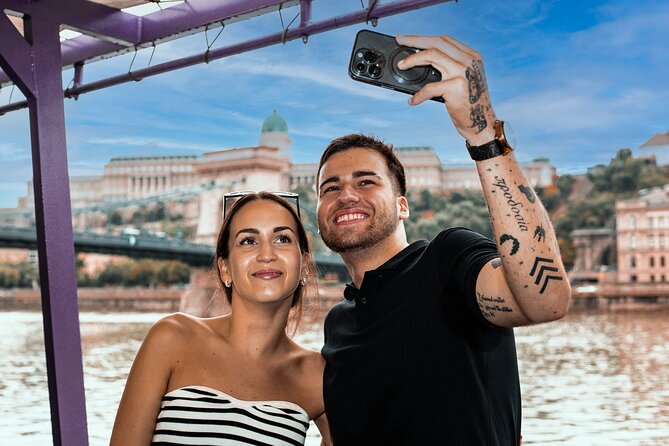
This is a classic “big hits, no fuss” Budapest experience. For about an hour, you float along the Danube while the city’s two halves slide past: the landmark-heavy stretch around Parliament and the bridge-and-hill scenes that define Buda at night. At this price point, that matters. You’re paying for a view-heavy ride, not a long day of logistics.
The best part is how the river view changes your sense of scale. From land, Budapest can feel like a checklist of places. From the Danube, those places line up into a story: bridges connecting districts, hills rising behind them, and the skyline glowing after dark. If you’re short on time, this cruise is one of the fastest ways to get your bearings fast.
The itinerary also helps you feel like you’re moving across the city even though you’re staying on one boat. You pass major landmarks in a steady flow: Chain Bridge, Parliament, Gellért Hill viewpoints, and more.
You can also read our reviews of more boat tours in Budapest


Starting at Jane Haining rkp 11: Boarding, Seats, and the Real-Life Line
Your meeting point is Jane Haining rkp. 11, 1052 Hungary, and the cruise ends back at the same spot. It’s near public transportation, and you’ll use a mobile ticket to get on.
Here’s the practical advice that makes or breaks this cruise: arrive early. People report long lines and chaotic boarding, with the best positions grabbed fast. If you want a seat where you can actually see out and photograph without contorting your body, build in extra time before the stated departure.
On the boat itself, seating is a tradeoff:
- The upper open terrace is where you’ll get the best air and the best sightlines, but it’s often cold, especially at night.
- The indoor seating can be more comfortable, but views can be affected by windows and the way the boat is set up.
- Some people recommend the upper deck for viewing, but if you’re sensitive to smoke, you may want to choose your spot carefully since smoking has been reported on the top area.
Also keep in mind the group size. Even though the cruise is only around an hour, it can involve a full boat, with a stated maximum of 500 travelers. That means you should expect shoulder-to-shoulder moments, especially near entry points and stairways.
And a simple rule: the operator may refuse boarding if you appear intoxicated.
Audio Guide on Your Phone: English Notes, No Loudspeakers
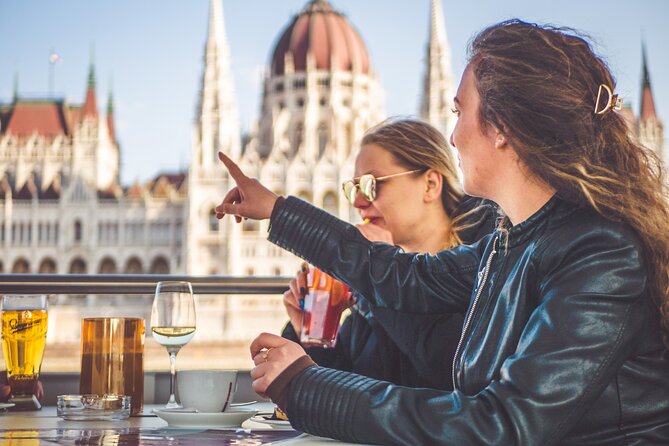
The audio guide is included, but it works differently than a typical guided tour. There’s a free downloadable application for your mobile devices, and the commentary is not broadcast through loudspeakers. You’ll need your own earphones to hear it.
That detail changes what you should do before you board:
- Bring headphones that actually work with your phone.
- Charge your device fully. Once you’re on the boat, the rhythm of the route doesn’t wait for a dead battery.
- If your audio starts late or glitches, you might miss the spoken explanations during the key landmark moments.
One more thing: your audio won’t automatically help if you’re staring at the wrong side of the boat. As the landmarks slide by, keep your eyes on the matching views outside, and let the audio tell you what you’re looking at.
The cruise is offered in English, so this is ideal if you want language clarity without paying for a private guide.
Parliament and the Bridge Chain: The Best Stretch for Night Photos
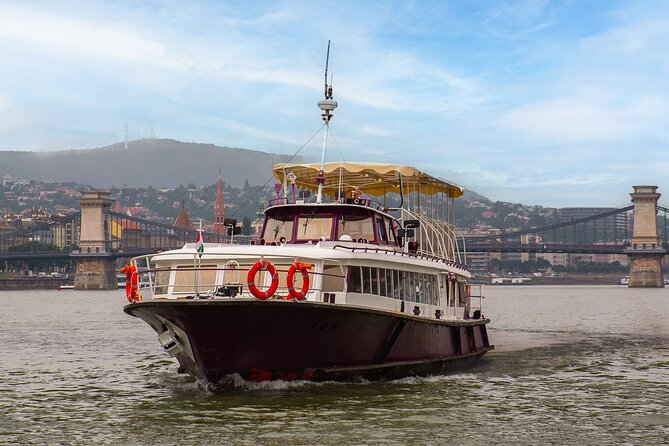
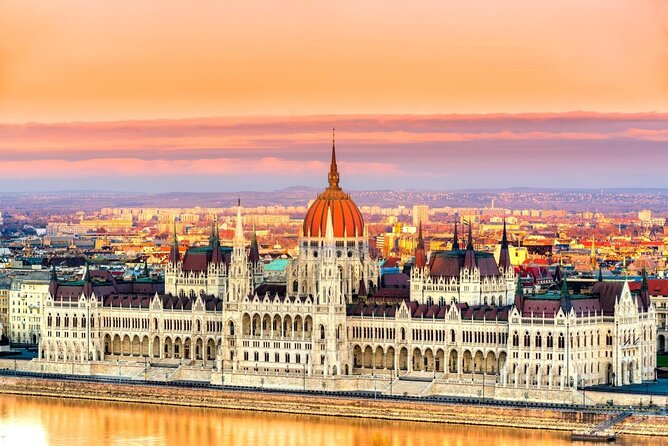
The heart of the route is the cluster around Budapest’s most famous postcard angles. You cruise along the Danube past the House of Parliament, widely regarded as one of the most beautiful government buildings in the world. From the river, it doesn’t feel like a single building. It reads as a whole scene of lights, reflection, and scale.
Right before and after that area, you’ll also pass:
- Chain Bridge: the first permanent stone bridge connecting Buda and Pest.
- Margaret Bridge: the second permanent stone bridge, built about 20 years after its ancestor.
These bridges aren’t just pretty objects. They’re visual anchors for the way Budapest developed into two sides with one shared city center. When you see them from the water, you understand why locals obsess over river crossings. Every bridge is both a connector and a viewpoint platform, and the cruise gives you a moving vantage point.
If you care about photos, think about timing. The cruise can cover the shift toward dusk or into full night depending on your departure. Either way, Budapest’s lighting tends to look best after dark, and reflections on the Danube can turn a basic skyline shot into something special.
Castle District at Night: Bazaar Gardens and the Buda Hills Glow
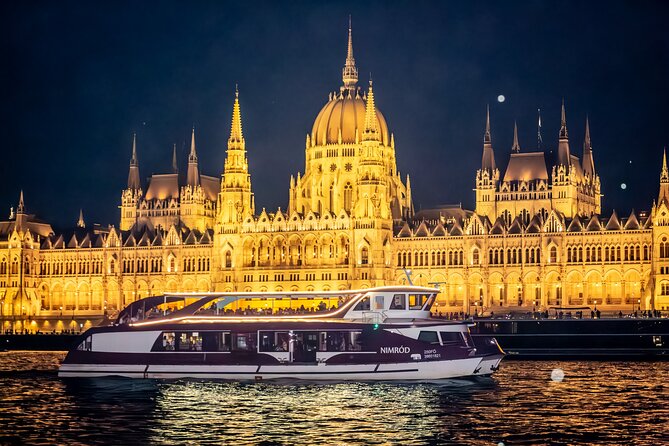
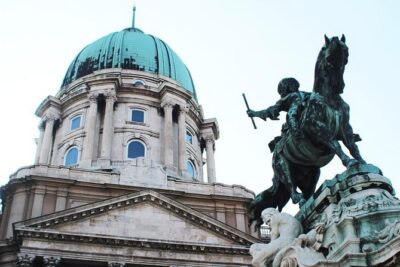
One of the most memorable moments comes when the route frames the Castle District, including the area near the Bazaar Gardens. This is the part of Budapest that sits up on the hills of Buda, so it naturally looks dramatic from the river.
At night, those elevated streets and historic contours become a layered backdrop. Even if you don’t hop off to explore, you get that “top of the city” feeling without the climb.
Then you’ll continue into a viewpoint-heavy section that leads you toward Gellért Hill.
You can also read our reviews of more guided tours in Budapest





Gellért Hill From the Water: Elisabeth Bridge and Liberty Bridge Views
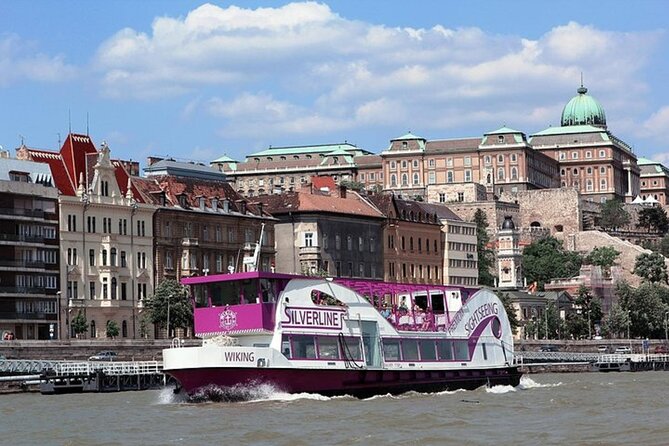
You emerge near the foot of Elisabeth Bridge, and from there the route brings you toward Gellért Hill, one of the capital’s most visited spots for its amazing views. The cruise helps you spot why people walk uphill there: the vantage point is the point.
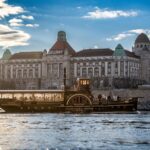
You also pass Liberty Bridge. At the Buda side, it’s part of the connection route to Gellért Hill and Hotel Gellért, which is linked with one of Budapest’s famous thermal baths. You don’t need to know the bath details to enjoy the view from the Danube, but it’s helpful context. This stretch shows you where relaxation spots live relative to major skyline points.
From the river, you’re basically seeing Budapest’s daily “route logic”: where the crossings land, where hills rise, and which buildings act as landmarks from multiple angles.
The In-Between Stops: Universities, Theatres, and Balna on the East Bank
After the major bridge-and-hill highlights, the itinerary keeps rolling through city landmarks that you might otherwise miss if you’re only focused on the biggest names.
Here are the standout stops to watch for, and what to make of them:
- Budapest University of Technology and Economics (BME)
This is described as Hungary’s most significant technology university, and it’s considered the world’s oldest institute of technology with a university rank and structure. It was the first institute in Europe to train engineers at university level. From the water, it’s a reminder that Budapest’s identity isn’t only architecture. It’s also institutions and education built into the city fabric.
- Petőfi Bridge
Originally built in 1933, it was blown up during WWII and rebuilt in 1952. You’ll get the bridge as a structure, but knowing the backstory helps you notice the resilience baked into the city’s crossings.
- New National Theatre
This is the most distinguished venue for theatrical plays in Hungary, with a permanent home since 15 March 2002. From the river, it’s one of those buildings that makes Budapest feel like a living capital, not just a museum.
- Balna (Whale)
The Whale-shaped modern shopping, cultural, and entertainment center is on the east bank. It’s a different style from the classic landmark scenery. If you’re curious about what Budapest looks like beyond the historic core, this is your clue.
If you’ve got a limited time window, these in-between stops are a bonus. They keep the cruise from turning into a one-note “buildings, buildings, buildings” ride.
Margaret Island, the Danube Green Break, and a Change of Pace
You’ll also pass the island between the banks of the Danube, which works like a green oasis. In summer, the emerald spaces are much enjoyed by locals and tourists.
Even at night (when the color may be more subdued), the island still reads as a break in density. It changes how the city looks from the water because it interrupts the usual run of bridges and buildings.
Think of Margaret Island as a breather in the visual storytelling. It gives the skyline a pause so the “big landmarks” stand out more when they return.
Batthyány Square and Szent Anna-templom: Baroque Beauty at the Edge of the Route
Near the end of the cruise, you’ll come into Batthyány Square, noted for Szent Anna-templom (Church of Saint Anne). This Roman Catholic church was built by the Jesuits between 1740 and 1761 and is listed as one of Budapest’s most beautiful baroque buildings.
You’ll also notice that the square is known for a market hall. That detail matters if you’re the kind of traveler who likes to understand daily life. The river cruise can easily feel like you’re only seeing monuments, but this ending portion connects the view back to neighborhoods where people shop and gather.
Price and Comfort: Is $14.40 Good Value?
At $14.40 per person, this cruise is priced for maximum sightseeing per hour. You’re not paying for a lengthy guided walk, and you’re not paying for a premium add-on like a private boat. Instead, you’re paying for an efficient river route through some of Budapest’s most recognizable landmarks, with an audio guide included.
What you should weigh is comfort vs. cost:
- If you’re okay with crowds and want the best value, this works.
- If you’re very sensitive to cold or tight space, you’ll need to plan your deck time carefully and dress for wind off the water.
- If you care most about commentary, remember the audio guide is delivered on your phone with earphones, not an onboard speaker tour.
On the upside, you’ll likely feel like the cruise is a bargain because Budapest’s top sights are all stacked along one smooth route. One hour on the Danube can replace multiple short rides and viewpoint stops.
On the downside, the experience can feel less relaxed if you’re expecting a calm, spacious sightseeing boat. Some people report that finding the best spots takes time and that the early part can be busy while people line up to board.
Should You Book This Danube Cruise?
Book it if:
- You want a quick Budapest highlight run with big landmarks and bridge views.
- You’re comfortable using a mobile audio guide and bringing your own earphones.
- You like river perspectives more than museum-style touring.
Skip it or reconsider if:
- You hate crowds and tight movement on boats.
- You don’t want to deal with cold open-deck conditions.
- You expect loudspeaker narration or a traditional guided commentary experience from a staff member.
My practical take: for the price, this cruise is hard to beat as a first-night or first-city visit plan. If you show up early, wear warm clothes, and keep your phone audio ready, you’ll get the Budapest essentials in a way that feels efficient and genuinely scenic.
FAQ
How long is the Budapest Danube sightseeing cruise?
The cruise lasts about 1 hour.
How much does the cruise cost?
It costs $14.40 per person.
Is the audio guide included, and how do I listen to it?
Yes. The audio guide is included and comes as a free downloadable application for your mobile device. The commentary is not broadcast through loudspeakers, so you should bring and use your own earphones.
What language is the audio guide in?
The audio guide is offered in English.
Where does the tour start?
The meeting point is Budapest, Jane Haining rkp. 11, 1052 Hungary, and the activity ends back at the same point.
Are food and drinks included?
Food and drinks are not included. You have an option to purchase them during the cruise.